
Feeling like you can never make up your mind? You’re not alone. Decision-making paralysis is an all-too-common mental health challenge faced by many women, including Christian married women. It’s that feeling of being unable to make a choice or potentially making the wrong one, even when presented with seemingly great options. This disorder has been studied extensively and can really weigh on our emotional well-being if we don’t understand it, address it, and try to find ways to manage it.
Doing research in this area can help provide understanding for how decision-making works in general. You’ll also gain insight into proven approaches for overcoming indecisiveness while regaining direction and confidence in each decision made.
Let’s go through what decision-making paralysis is and how it affects Christian married women specifically and explore the various causes behind it. Then, we’ll share some tips for finding clarity when guidance feels hard to come by. So buckle up—you’re about to embark on a journey that could very likely change your life forever!


Avoiding Decision-Making Paralysis: Tips for Finding Clarity with Guidance
What is Decision-Making Paralysis?


Avoiding Decision-Making Paralysis: Tips for Finding Clarity with Guidance
Making decisions can be difficult and daunting for many, especially when the stakes are high. In some cases, what was once a straightforward decision becomes an arduous choice requiring exhaustive analysis and contemplation. This mental state is dubbed decision-making paralysis, which is anxiety-inducing overthinking that hinders our ability to confidently choose a course of action.
Definition
Decision-making paralysis, also known as analysis paralysis, is a psychological condition that occurs when individuals become too overwhelmed to make decisions. It can be caused by a number of factors, such as anxiety, perfectionism, fear of making the wrong choice, or overthinking any decision point.


Avoiding Decision-Making Paralysis: Tips for Finding Clarity with Guidance
People in this situation may struggle with indecisiveness and procrastination, and they may experience feelings of guilt and uneasiness for not being able to come up with an answer immediately. The inability to decide can lead to frustration, stress, confusion, and even depression for many. Thankfully, there are ways to overcome decision-making paralysis. We can start by identifying its source within ourselves using self-awareness.
Causes
- Fear of making mistakes: Many people experience paralyzing fear when faced with making a decision, particularly when there is potential for adverse outcomes or errors. This fear can be rooted in experiences, traumatic or otherwise, that have led to the development of this defensive response.
- Fear of regret: This can cause individuals to second-guess their decisions or continuously compare options in an effort to make the most correct choice. Regret can lead to feelings of uneasiness and guilt that prevent an individual from taking any action at all.
- Analysis paralysis: Too much information can lead to indecisiveness as individuals become overwhelmed by the large number of available options, leading them to over-examine details or data points as they attempt to make a sound decision.
- Decision fatigue: Mental fatigue affects our cognitive processes and diminishes our capacity for thinking critically and abstaining from instant gratification and impulsivity, which can contribute to decision-making paralysis.
- Desire to avoid adverse outcomes: Oftentimes, decisions carry risks of certain losses or harms, which can lead some individuals to delay making a conscious choice in order to keep the probability of unwanted outcomes low.
Consequences
Decision-making paralysis can be detrimental to your husband’s mental and emotional well-being. When suffering from too many choices, anxiety and stress levels can increase as we struggle to make decisions that will affect our future or relationship.
Decision-making paralysis affects your husband’s ability to make important choices for your marriage, family, and themselves, ultimately diminishing self-confidence and leading to feelings of frustration when things don’t go according to plan.
According to peer-reviewed studies, decision paralysis has been linked with increased risk of depression and other psychological disorders, such as panic attacks and ADHD. Additionally, it can cause physical pain due to uncontrollable ruminating thoughts that prevent people from being able to switch off or relax. That contributes to feelings of burnout or overwhelm in the long term if not addressed appropriately.
Tips for Overcoming Decision-Making Paralysis


Avoiding Decision-Making Paralysis: Tips for Finding Clarity with Guidance
From understanding the source of our mental roadblocks to seeking guidance and trusting our unique decision-making styles, there are tangible steps we can take to reach clarity with confidence.
As Christians, God is always available to guide us. Proverbs 3:5-6 says, “Trust in the Lord with all your heart, And lean not on your own understanding; In all your ways acknowledge Him, And He shall direct your paths.”


Avoiding Decision-Making Paralysis: Tips for Finding Clarity with Guidance
Identifying the Source
Identifying the cause of decision-making paralysis is key to overcoming it. Some common culprits include fear, need for control, feeling overwhelmed and anxious by too much information or lack thereof, inability to weigh pros and cons in an unbiased manner, and perfectionism that sets unrealistic expectations. Christian married women can begin the process of helping their husbands by getting clear on what emotions they are experiencing when making choices.


Avoiding Decision-Making Paralysis: Tips for Finding Clarity with Guidance
Are they worried about looking bad? Do they want to please somebody else? Taking the time for self-examination in this way may help reveal hidden issues at play behind their feelings of indecision. Additionally, consulting a therapist can be useful if deeper underlying mental health issues related to self-esteem, working memory, or executive functions inhibit decisions. Paying attention here will help them gain clarity on the source and provide direction toward solutions.
Seeking Guidance
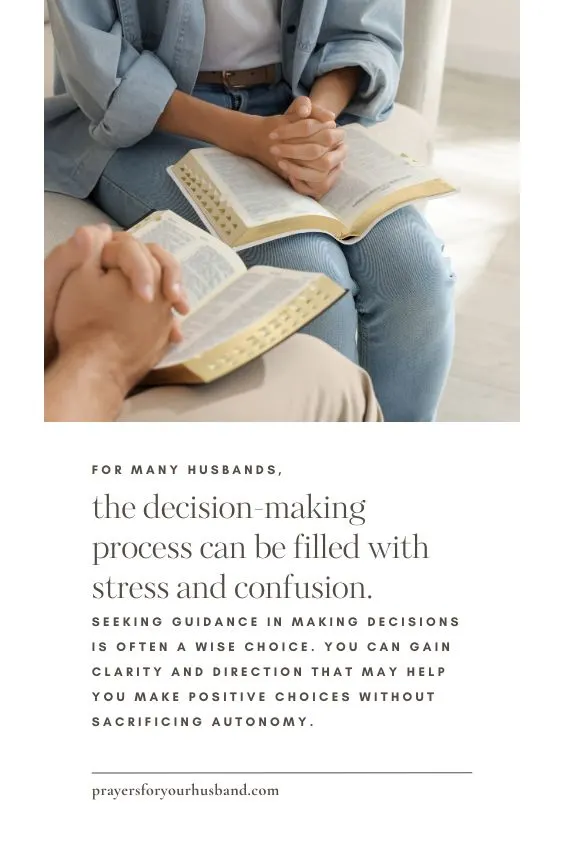
For many husbands, the decision-making process can be filled with stress and confusion. Seeking guidance in making decisions is often a wise choice. You can gain clarity and direction that may help you make positive choices without sacrificing autonomy.

Avoiding Decision-Making Paralysis: Tips for Finding Clarity with Guidance
From consulting experts to talking with friends or even praying for answers, seeking external perspectives provides insight into potential options at hand and allows us to take our time before making any commitment.
Not only does seeking guidance mean we are not alone while considering our choices, but it also helps protect against potential consequences as we evaluate the various possibilities involved in each option. Receiving advice from trusted sources gives us an additional layer of confidence when we have difficulty deciding ourselves. It allows us access to information, events, or new ideas that might have been overlooked otherwise.
Trusting Your Decision-Making Style
At its core, trusting your own ability to make the correct decisions requires self-awareness. Husbands need to take a step back and assess their strengths and limitations as well as their tendencies for overthinking or making hasty choices. This also means being honest with themselves about biases that may come into play when it comes time to decide. Once they can identify these internal conflicts, it will give them more control over their decision-making process.
Utilizing the power of prayer and reflection is one way to practice becoming an intuitive decision-maker. By taking a calm moment in stillness—pausing to ask God’s guidance in how He wants them to move forward—wives can discern what their husbands are called upon to do next before evaluating various options.
Conclusion
In conclusion, decision-making paralysis is an obstacle that many of us face on a daily basis. But with the right mindset and strategies in place, we can move past it and make decisions confidently.
First, identify what’s causing the paralysis—whether it be a lack of information, clarity, or confidence. Then create distance from the situation; take some time to assess your goals and priorities as well as any factors at play before making a choice. Additionally, seek guidance from people you trust who can give perspective on different aspects of the issue to help ease decision-making. And finally, trust your own judgment; self-belief goes a long way in overcoming decision-making paralysis!
Remember these tips for overcoming analysis paralysis while making key life decisions and investments. They can reduce fear and excessive mental effort required in the decision-making process, which will allow you to focus more strength on the execution phase of any project/task assigned by God or yourself!
FAQs
1. What is decision-making paralysis?
Decision-making paralysis is when people struggle with making a choice due to the anxiety of making the wrong one. It can be caused by many different factors, such as cognitive biases, rumination, and choice overload.
2. How can I tell if my overthinking is normal or something more serious?
If your thoughts are persistent and excessive enough that they impair your ability to make decisions or approach a challenge, it might be wise to consult with a mental health professional for further guidance.

Avoiding Decision-Making Paralysis: Tips for Finding Clarity with Guidance
3. Are there any strategies I can use when dealing with decision-making paralysis?
Take note of irrational cognitive biases that may contribute to indecisiveness, and learn how you can reframe them constructively. Additionally, create structured actionable steps, like drawing up options into charts for comparison.